![[AISI LOGO]](https://www.steel.org/wp-content/themes/steel-org/assets/images/steel-logo.png) American
Iron and Steel
Institute
American
Iron and Steel
Institute
SteelBriefs | Rep. Raja Krishnamoorthi (IL-08)
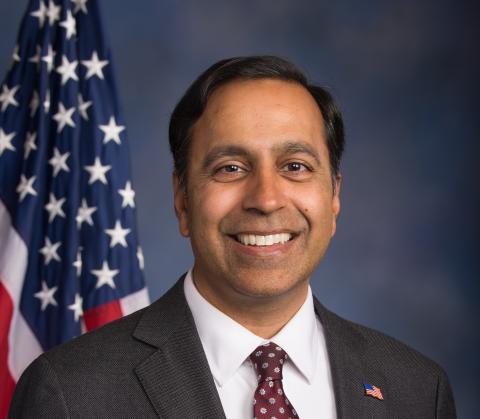
Rep. Raja Krishnamoorthi (IL-08)
Congressman Raja Krishnamoorthi was elected to Congress in 2016 and is now in his fourth term representing Illinois’ 8th District, which includes Chicago’s west and northwest suburbs as well as the 41st ward of the city. He serves as Ranking Member of the Select Committee on the Strategic Competition Between the United States and the Chinese Communist Party, making him the first South Asian American in history to lead a Congressional Committee. He also serves on the House Permanent Select Committee on Intelligence and the Committee on Oversight and Government Reform as Ranking Member of the Subcommittee on Health Care and Financial Services. The Congressman is a Vice-Chair of the Equality Caucus and Co-Chair of the Congressional Asian Pacific American Caucus (CAPAC) Immigration Task Force. In addition, he is the founder and Chairman of the bipartisan Congressional Caucus to End the Youth Vaping Epidemic and the bipartisan Solar Caucus.
Representative Krishnamoorthi is the child of immigrants and was raised in Peoria, Illinois. He attended public schools in Peoria and was a valedictorian of his high school class. Scholarships and student loans allowed him to graduate summa cum laude from Princeton University with a degree in mechanical engineering and a certificate from the Princeton School of Public and International Affairs. He then graduated with honors from Harvard Law School and clerked for a federal judge before practicing law in Chicago.
Representative Krishnamoorthi pursued public service while practicing law and was appointed by Illinois Attorney General Lisa Madigan as a Special Assistant Attorney General to help start the state’s Public Integrity Unit created to root out corruption in Illinois. As a member of the Illinois Housing Development Authority, the Congressman chaired the Audit Committee, helping to provide thousands of low and moderate-income families across the state with affordable housing. Congressman Krishnamoorthi also served as Illinois Deputy Treasurer, where he oversaw the state’s technology venture capital fund and helped make programs such as the state’s unclaimed property program leaner and more efficient.
After his time in the Illinois Treasurer’s Office, Representative Krishnamoorthi returned to the private sector, serving as president of research-oriented small businesses developing technology in the national security and renewable energy industries. Representative Krishnamoorthi also served as the Vice-Chair of the Illinois Innovation Council and co-founded InSPIRE, a non-profit that provides inner-city students and veterans with training in solar technology.
The Congressman resides with his wife Priya, a physician, and 3 children in Schaumburg, Illinois.
More information on Representative Krishnamoorthi can be found on his website, Facebook, Twitter and Instagram.
You can follow #SteelBriefs on the American Iron and Steel Institute Twitter, LinkedIn and Facebook channels, as well as here, on Steel.org.
Why is the steel industry important to America?
The steel industry in the United States has historically been a provider of good jobs that pay family-sustaining wages. The U.S. steel industry once supported hundreds of thousands of jobs across the country, providing the foundation for thriving local economies with a strong middle class.
The steel industry also has strategic value to our nation’s economy. Steel is an essential component of what moves and protects America. Steel products are found in our roads, bridges, cars, and buildings. Furthermore, steel has a number of important defense applications. American-made steel plates the sides of armored vehicles that protect our soldiers and propels our naval ships. When we secure critical supply chains here in the U.S., we are less vulnerable to the economic coercion of bad actors like the Chinese Communist Party (CCP), which has used its command of supply chains to jeopardize the security and stability of the U.S. and other nations.
Describe the critical issues facing the American steel industry.
It’s no secret that the U.S. steel industry has been fighting unfair trade practices and non-market policies for decades. What remains of a once thriving industry in the U.S. faces no shortage of challenges. The CCP’s unfair trade policies and practices have been one of the biggest contributors to our steel industry’s decline. By unfairly subsidizing production and dumping that product in the United States, the PRC undercuts the fair market value of steel and makes it impossible to compete. Even when the U.S. government negotiates fair trade deals with economic partners or enhances our trade protections, the CCP opens a new backdoor into our economy.
Despite all the progress we have made in recent years to reinvigorate our steel economy, capacity utilization rates still hover below 80 percent and investment in existing and new facilities remains low.
Explain the “Protecting American Industry and Labor from International Trade Crimes Act” and why it is important for the domestic steel industry.
H.R. 1869, the Protecting American Industry and Labor (PAIL) from International Trade Crimes Act, establishes a new task force in the Department of Justice dedicated to criminally prosecuting transshipment, fraud, and other trade-related crimes. Chinese companies violate U.S. trade laws and protections like antidumping duties at will, which seriously harms U.S. steel and steel product manufacturers, among many others, that play by the rules. We can’t continue allowing state-backed firms in the PRC we have charged with dumping their products in our market to just ship those same products through third countries to avoid antidumping duties. This bill would hold those companies criminally liable for their actions and strengthen deterrence against future violations.
Our industry’s legislative priorities are ensuring unfair trade practices are addressed, a level playing field is established and the Section 232 steel tariffs are preserved. What are your thoughts on these issues?
In addition to the PAIL Act, I was proud to co-lead the introduction of Leveling the Playing Field 2.0 Act as well as the Fighting Trade Cheats Act in the 119th Congress. This suite of legislation is vitally important to the U.S. steel industry but also to our strategic competition with the CCP. So too are the protections extended to the industry by Section 232 tariffs. However, the steel industry needs more than protection from bad actors like the CCP. Congress should support solutions for efficiency and new environmentally friendly steelmaking while ensuring integrated facilities have the resources they need to maintain their competitive edge in the global marketplace.
Do you have any other comments or statements about the steel industry?
We talk a lot about how the U.S. steel industry is important to our economic and national security. Nowhere do I think this is more apparent right now than in the U.S. shipbuilding sector. For decades, we ceded our shipbuilding capacity to other nations including the PRC. And now, for every three-hundred and fifty-nine large oceangoing vessels China builds, the United States builds one. Ships, both commercial and naval, require a lot of steel. As we work to revitalize the U.S. shipbuilding sector, we will breathe new life into upstream demand for U.S.-made steel and steel products. If we do this right, we have a chance to rebuild a part of our economy that has been left out in the cold for decades while overtaking one of our greatest adversaries in a strategically important sector.